Event catering best practices for corporate facilities change completely somewhere around the 300-guest mark. Below that line, catering is hospitality with logistics attached; above it, catering is logistics with hospitality attached. A 500-person event succeeds or fails on arithmetic decided weeks earlier: service lines, staffing ratios, load-in windows, and power. We have run large corporate catering operations across Bay Area campuses, conference venues, and converted warehouses since 2011, and this is the playbook.
The Math That Governs Everything
Memorize three ratios and most large-event decisions make themselves:
| Resource | Ratio | At 500 guests |
|---|---|---|
| Buffet lines (double-sided) | 1 per 100 to 125 guests | 4 to 5 lines |
| Service staff (buffet/stations) | 1 per 25 to 30 guests | 17 to 20 staff |
| Bartenders | 1 per 65 to 75 guests | 7 to 8 bartenders |
The buffet line ratio is the one facilities teams resist, because five double-sided lines consume serious floor space. But the alternative is arithmetic, not opinion: a single double-sided line serves roughly 4 guests per minute, so 500 people through two lines means dinner takes over an hour and the last hundred guests eat cold food angrily. Identical menus at every line, distributed across the room, with clear signage. Mirrored stations also break up crowding in a way that one giant food wall never does.
Format: Stations Beat One Big Buffet at Scale
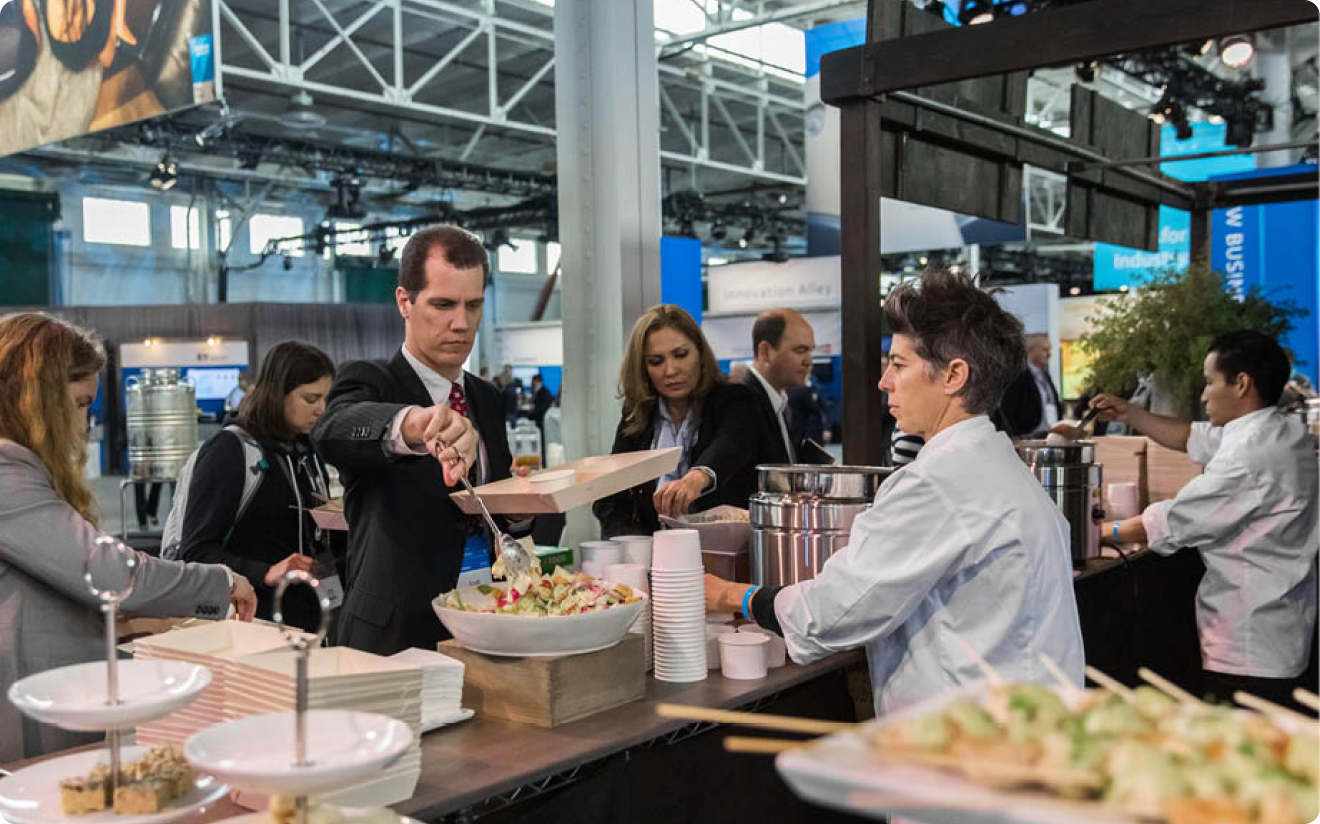
For corporate catering for large events, distributed stations are usually the strongest format, and not for aesthetic reasons. Stations self-balance crowds: guests flow toward shorter lines, the room circulates instead of queuing, and dietary-restricted guests find their station instead of interrogating a 40-foot buffet. A 500-person evening event might run a carving station, a taco station, a grain bowl and salad station, a dim sum station, and a dessert wall: five micro-restaurants, each staffed, each with its own service rhythm.
Plated service at 500 is achievable but belongs to galas with full banquet kitchens and budgets at the top of the $65 to $85 per person full-service band; for most corporate facilities, stations deliver more satisfaction per dollar.
The Facilities Walkthrough: Where Events Are Actually Won
Three weeks out, your caterer should walk the facility with your operations contact. The agenda, from 14 years of these walkthroughs:
- Load-in path and timing. A 500-person event moves literal tons of equipment. Dock availability, freight elevator dimensions, and the walking distance from dock to service area dictate the crew schedule. At 500 guests, setup starts 4 to 6 hours before doors.
- Power audit. Hot-holding cabinets, induction stations, and coffee brewers draw real amperage. Corporate facilities have plentiful power that is always in the wrong place; we map circuits at the walkthrough, not on event day.
- Kitchen reality. Most corporate facilities offer warming kitchens, not production kitchens. The professional answer is full off-site production with on-site finishing, which is how we run every large event; confirm your caterer’s kitchen can produce at your volume.
- Trash and water. Five hundred guests generate a dumpster-scale waste stream and constant water needs. Boring, decisive, and always someone’s forgotten line item.
- COI and security. The certificate of insurance, vendor registration, and staff security list need to clear facilities approval a week out, not the morning of. A crew of 20 stuck at a badge desk is a delay no kitchen can cook its way out of.
Dietary Logistics at Scale
At 500 Bay Area guests, expect 125 to 175 with dietary preferences or restrictions. The practices that hold at this volume:
- Survey at registration, not by email chain. The RSVP form carries the dietary question.
- Design coverage into the stations rather than bolting on a sad vegan table. Every station carries at least one vegan and one gluten-free option; the taco and grain bowl stations do heavy lifting here.
- Label every item with ingredient cards including the big-eight allergens. At scale, verbal answers from staff cannot keep up.
- Severe-allergy protocol: individually plated, sealed meals matched to named guests, run by the service lead personally. This is the one place large corporate catering must operate like fine dining.
Timeline and Communication
Booking lead time at this scale is 8 to 12 weeks minimum, longer for fall dates when conference catering Bay Area calendars collide with corporate holiday season. The planning sequence mirrors our standard corporate event catering guide, with two scale-specific additions: a named caterer-side event lead with radio communication to your facilities and AV teams, and a written minute-by-minute run of show. When the keynote runs 20 minutes long (it will), the catering lead re-times 5 stations and 20 staff in real time. That coordination is what you are buying at the full-service tier.
Budget framing: staffed station events at this scale land in the $45 to $85 per person range plus an 18 to 22% service charge, with per-head efficiency improving past 300 guests; the detailed cost mechanics are in our bay area office catering pricing guide.
The Three Failure Modes (and Their Antidotes)
After hundreds of large events, failures cluster in exactly three places:
- Underbuilt service capacity. Too few lines, dinner takes 70 minutes, the event’s energy dies in a queue. Antidote: the ratio table above, enforced against floor-space pushback.
- Compressed load-in. Venue access granted at 4 p.m. for 6 p.m. doors. Antidote: negotiate facility access when booking the date, not after.
- Untested assumptions about the facility. The dock that closes at 5, the elevator that fits half a hot box, the circuit that trips under two coffee brewers. Antidote: the walkthrough, every time, no exceptions.
FAQ
How many caterers or staff do you need for 500 guests?
Plan 17 to 20 service staff for stations or buffet service, 7 to 8 bartenders, plus a kitchen team and a dedicated event lead: roughly 30 to 35 total catering personnel.
How much does it cost to cater a 500-person corporate event?
At $45 to $85 per person full-service plus an 18 to 22% service charge, realistic 2026 Bay Area totals run $27,000 to $52,000 depending on menu tier and bar program.
How long before a large corporate event should catering setup begin?
4 to 6 hours before doors for a 500-person event, assuming off-site food production. Facility access shorter than that should be renegotiated before signing the venue contract.
What is the best food service format for very large corporate events?
Distributed, mirrored food stations: they self-balance crowds, absorb dietary variety, and keep a 500-person room circulating instead of queuing at one buffet wall.
Scale Is a Discipline
Event catering best practices for corporate facilities at the 500-person level come down to honoring the math: enough lines, enough staff, enough load-in time, and a facility walkthrough that replaces assumptions with measurements. Do that, and 500 guests eat as well as 50.
Pinx Catering has run large corporate event catering and enterprise event food programs across Bay Area facilities since 2011: founder-led, ratio-obsessed, and built on elevated comfort food that holds at volume. Request a quote at pinxcatering.com with your headcount and venue, and we will start with the walkthrough.